
You may well have heard the term “Occupational Certificate” if you’re constructing a new house, renovating an existing home or developing a property in Sydney or anywhere else in New South Wales. So, what is it exactly, why is it important and what is the difference between an interim and an final one? This guide explains everything in simple terms so you can be sure you know what you’re up against.
What Is an Occupation Certificate in NSW?
An Occupation Certificate (OC) is a legal certificate issued in New South Wales under the Environmental Planning and Assessment Act 1979. It certifies that a building (or a part of a building) is fit for purpose and that the construction work has been completed in compliance with the development consent and the Building Code of Australia.
The OC certificate is a legal instrument required to enter or use a newly constructed building in NSW without it, there is no law to stop you. It is the last pass and approval from the certifier that assures the structure is safe and habitable or useable.
There are two kinds of Occupation Certificate that you will need to be familiar with: the Interim Occupation Certificate and the Final Occupation Certificate. Both are issued by an accredited Private Certifier (PC) or the local council.
Quick Fact: All new residential and commercial buildings, major extensions and change of use applications are required to be certified by an OC in NSW. One is required to be able to occupy and use a new building legally.
What Is an Interim Occupation Certificate?
Occupying a building or a portion of a building while it has not been completely finished may be authorized by an Interim Occupation Certificate (IC), also known as partial OC. It is a good option for developments that are large or staged, where sections of the development may be complete before the rest.
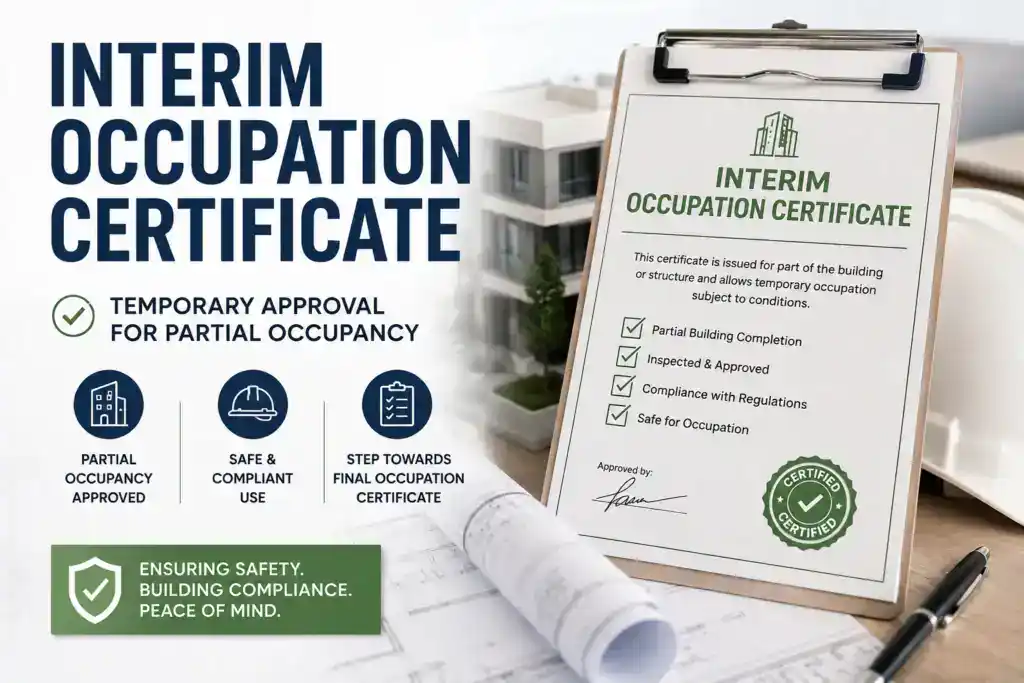
For instance, a multi-level apartment block in Sydney in which the lower levels are ready and secure to inhabit, but amenities on the roof or some retail businesses on the bottom level are still being built. In this instance, a certifier may grant an interim occupation certificate for the work that is complete, and the residents can move in while the remaining work is done.
When Is an Interim Occupation Certificate Issued?
- If there is a staged development, some of it is not finished and the finished part complies with safety and compliance standards.
- A building that has been basically finished but still requires minor work or defects to be rectified.
- If some external works, such as the landscaping or marking of the car park are still outstanding but the external area that is occupied is safe.
- Where a commercial building must be in use prior to the completion of fit-outs for all tenants.
It is crucial to note that an interim occupation certificate does not imply that the project is compliant in all aspects – it only certifies the safe part of the project. The excellent works are still to be completed to receive a final certificate.
What Is a Final Occupation Certificate?
The final all clear is a Final Occupation Certificate. It is given when the entire building, including all floors, areas and systems, has been built to the development consent, the Construction Certificate and the Building Code of Australia. No outstanding works, outstanding conditions on the development consent or outstanding inspections at this time.
Final occupation certificate is issued when the building is fully compliant, safe and ready for use in its entirety. As a Sydney homeowner, this document is the one you don’t want to lose before you make your last payment to your builder and complete the purchase of your new home.
What Does the Final Occupation Certificate Cover?
- Assurance that all critical stage inspections are completed.
- Conditions for development have been met.
- Fire safety systems are in place and functioning—such as sprinklers, alarms, and exit signs.
- Structural Integrity signed off.
- Waterproofing, drainage and compliance for wet areas have been verified.
- Where required, energy efficiency measures are in place.
Note: It is a legal requirement in NSW to have a final occupation certificate before taking up occupation of any new dwelling or commercial building. This failure may lead to substantial fines and legal difficulties for property owners and developers.
Difference Between Interim OC and Final OC in Sydney
Both documents are issued under the same legislation, but have different meanings and implications. Although both documents are issued under the same legislative framework, they have different meanings and implications.
| Feature | Interim Occupation Certificate | Final Occupation Certificate |
| Scope | Part of the building or a staged portion | Entire building, all areas |
| Stage of construction | Partially complete | Fully complete |
| Outstanding works | Minor or remaining works may still be pending | No outstanding works permitted |
| Common use | Staged residential developments, large commercial projects | All new homes, buildings, and major renovations |
| Legal effect | Allows occupation of specified portion only | Full legal clearance for the whole building |
| Follow-up required? | Yes, a final OC must be obtained once all works are done | No further certificates required |
For larger residential projects or mixed use projects it is fairly standard for the project to progress through the interim occupation certificate stage and then move on to the final occupation certificate. It is always important for buyers and investors to check whether it is a money purchase certificate or an investment certificate before signing a settlement.
Why Is an Occupation Certificate Needed in NSW?
There are very practical reasons for the existence of the OC certificate in NSW. Properly inspected and approved buildings are not necessarily safe, they may fail, catch fire or be waterproofed incorrectly. The NSW Government has established the Occupation Certificate regime to ensure that all buildings in which people live and/or work comply with minimum standards for safety and quality.
Legal Reasons
In NSW, it is a legal requirement under the Environmental Planning and Assessment Act 1979 and its regulations to have an OC certificate when occupying a new building. This is true for both homeowners and developers as well as tenants. Penalties may be imposed on developer and/or owner if they are found to be in possession of a building without a certificate.
Financial and Insurance Reasons
Sydney home insurers need an Occupation Certificate before they can offer building insurance coverage. Lenders and banks will also not pay the final progress payment to a builder – or complete a home loan – until they have received a final occupation certificate. This is a crucial step in any real estate transaction or building project.
Safety and Quality Assurance
A series of critical stage inspections are conducted during the construction of a building to obtain either an interim occupation certificate or a final occupation certificate. They examine the foundations, structure, fire protection measures, waterproofing, and more. This process can help prevent defects from being concealed behind walls and ceilings, and only be discovered years later at a high price to the homeowner.
Who Issues an Occupation Certificate in Sydney?
An Occupation Certificate is issued by an accredited private certifier in NSW. This can be a private accredited certifier (most commonly used for new construction in Sydney) or the local council. The Principal Certifier is appointed at the beginning of the project, and is also issued a Construction Certificate, then is kept on the project during the construction to conduct inspections at key stages.
The job of certifiers has been tightened up in recent reforms to the NSW building industry, with increased accountability through the Design and Building Practitioners Act 2020. This was partly as a result of the building defect scandals that had surfaced in Sydney, including the evacuation of apartment buildings due to structural and waterproofing problems.
What Happens If You Don’t Have an Occupation Certificate?
There are serious implications for people who take over or let others take over a building without an OC certificate in NSW. These include:
- Fines and penalties: The EPA Act carries stiff penalties for both developers and property owners.
- Insurance issues can be a problem: If a claim is filed on an uninsured or under-insured property it may be denied.
- Property sale problems: The Sale of a property without a final Occupation Certificate may cause delay or even the collapse of a sale, as solicitors and conveyancers will know this when they carry out the due diligence.
- Orders for the removal of persons from premises: Local councils in Sydney have powers to issue orders requiring a person to be removed from premises which are not held under the appropriate certificate.
Tips for Property Buyers and Developers in Sydney
If you’re planning to buy off-the-plan, custom build a new home or buy a property in Sydney, here are some tips that’ll help you:
- Be sure to check with your solicitor or conveyancer before the settlement as to whether the Final occupation certificate has been issued for the property.
- If you’re building, make sure your contract with your builder specifies when and how the interim and final occupation certificates will be obtained.
- Do not pay the last payment of construction until you have the final construction certificate.
- If buying in a staged development, specify if the unit or lot has an interim occupation certificate or a final occupation certificate.
- Make copies of all Occupation Certificates and store with property records, as you may need them in the future when selling, renovating and claiming insurance.
Frequently Asked Questions (FAQ)
Q. Can I move into my new home in Sydney without a Final Occupation Certificate?
Q. How long does it take to get an OC Certificate in NSW?
The timeline will vary, depending on the size and complexity of the project. The time for a standard new home in Sydney to receive a final occupation certificate depends on the final inspection, but is usually a few days to a few weeks once all conditions of development consent have been met and documentation is complete.
Q. What is the difference between a Construction Certificate and an Occupation Certificate?
A Construction Certificate (CC) is issued prior to construction, and indicates compliance with the Building Code of Australia and the development consent. An interim or final Occupation Certificate is given when the building is completed and shows that the building has been constructed according to the approved plans and is safe to use. CC is first, OC is last.
Q. What inspections are needed before a Final Occupation Certificate is issued in NSW?
Inspections that are usually required at a critical stage are: Pre-slab or footing inspections, frame inspections, wet area and waterproofing inspections, and a final inspection prior to the issuance of an occupation certificate. The required inspections will be explained to you by your Principal Certifier at the beginning of your project.
Q. Can an older property in Sydney be sold without an Occupation Certificate?
Most of the pre-Occupancy Certificate properties in NSW are likely not to have an Occupation Certificate on record and this is accepted. But if a property was not built with an OC certificate in NSW, it could cause concern for buyers, lenders and insurers when it comes to properties built after 1997. It’s important to always check with your solicitor before taking any action.