
Table Of Contents
- What is Construction Certificate?
- What Is a Complying Development Certificate (CDC)?
- Construction Certificate vs CDC: Side-by-Side
- Which Pathway is Faster?
- When a Complying Development Certificate Is Not an Option
- Where Fire Safety Fits In
- Do not forget to use the Finish Line!
- Key Takeaways
- Frequently Asked Questions
Waiting a week for your project to be approved will cost you money. Your finance continues to add up, trades move to other positions, and you miss your starting date. You will have to make one of the first decisions, which is to take the Construction Certificate pathway or the Complying Development Certificate (CDC) pathway.
They both result in a legal build, but have distinct speeds, eligibility, and flexibility. This guide will provide you with details about each of them so that you can pick the right one for you.
What is Construction Certificate?
A Construction Certificate verifies that your detailed construction plans and specifications meet the Building Code of Australia (BCA) and conditions of your development consent. It is after an approved Development Application (DA) from council.
That is, the DA asks, “Can I build this here?” The Construction Certificate provides the answer to the question, “Are these plans technically compliant and ready to build from?”
A Construction Certificate may be issued by either council or a registered certifier in NSW. The owner and developer of the property would prefer to work with a private certifier in Sydney, as they can select the time frame and method of communication, and they would not have to wait in long council queues.
What Is a Complying Development Certificate (CDC)?
A CDC is a quick approval for projects that are simple and conform to strict pre-set criteria in the State Environmental Planning Policy (Exempt and Complying Development Codes). If your build meets all the criteria (height, site coverage, landscaping, setbacks, etc.), you do not have to go through the DA process. CDC has approved planning and construction in one certificate.
Examples of common CDC projects are:
- New single and double-storey homes
- Granny flats
- Alterations and additions
- Garages, decks, pools and carports
- Some fit out and changes of use of commercial and industrial premises.
Construction Certificate vs CDC: Side-by-Side
| Factor | Construction Certificate (after DA) | Complying Development Certificate |
| Approvals needed | DA first, then Construction Certificate | One combined certificate |
| Who assesses | Council (DA), then council or certifier | Council or registered certifier |
| Typical speed | Slower, depends on DA assessment | Often much faster for eligible projects |
| Design flexibility | High, merit-based assessment | Low, must meet fixed standards |
| Neighbour notification | Usually required during the DA | Generally limited to notice before work starts |
| Best for | Complex, unusual or non-compliant designs | Simple, code-compliant builds |
Which Pathway is Faster?
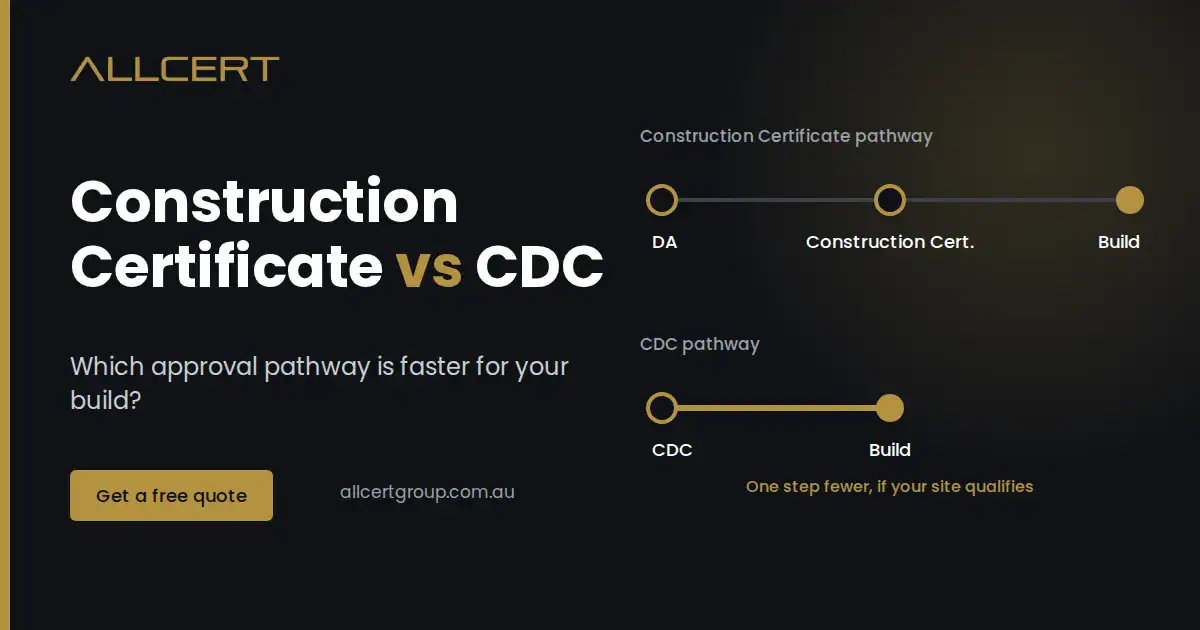
A Complying Development Certificate (CDC) typically takes less time for eligible projects. Without a DA stage, you will not have to wait for the council to assess it, neighbours to submit and request information about it. With a completed application, a CDC can be established in weeks, not months.
This is a two-step pathway to the Construction Certificate and takes longer. Prior to receiving your Construction Certificate, your DA will need to be determined. Assessment time will differ depending on the council’s workload, the complexity of your design and, if applicable, the need to make amendments to the application.
There is a catch. If your project is eligible, a CDC will be faster, but only faster. If your design is not approved as compliant, you could lose weeks, and then have to follow the DA route anyway. The most crucial moment to save time is checking the eligibility before committing to a pathway.
When a Complying Development Certificate Is Not an Option
You will typically need the DA and Construction Certificate pathway if:
- You own a site that is listed as a heritage site or in a heritage planning area.
- The lot is in a flood-prone, bushfire-prone or environmentally sensitive area, depending on the code requirements
- Lot size or irregularity prevents meeting code setbacks and coverage.
- Your design is not standard for development or requires a modification of development standards.
- Your project is a more extensive or complex development other than codes
A CDC may not be precluded by bushfire and flood constraints, but may include conditions and technical reports. A specialized evaluation of your website eliminates guesswork.
Where Fire Safety Fits In
In either case, fire safety remains. In cases of commercial, multi-unit, health and education buildings, as well as others, certain fire safety elements need to be outlined, installed, and certified. The required final fire safety certificate must be issued prior to the issuance of an Occupation Certificate and the owners are required to lodge an annual fire safety statement.
An early fire safety certificate in Sydney consultation helps avoid the dreaded last minute shock of a completed building that can’t be inhabited due to the lack of a fire certification.
How to Speed Up Either Pathway
- Involve your certifier, as early as possible. Hiring a private certifier at concept stage (before plans are final) allows for compliance problems to be resolved offsite and on paper rather than onsite.
- Submit complete documentation. The most common cause of “request for information” delays is missing details.
- Do an assessment with BCA first. Sydney BCA consultants are experts in detecting non-compliance and can suggest solutions to the performance issues prior to lodgement.
- Make sure to review constraints at the outset. Consider and think through zoning, overlays, easements and services early.
- Respond to queries within a day or two. A slow response slows down a quick operation.
- Schedule required checks. Schedule stage inspections in advance, so that your builder doesn’t have to wait on a certifier.
Do not forget to use the Finish Line!
They both lead to the same final destination – an Occupation Certificate. It certifies the completed building to be fit for use. Even if the building is finished, documents like fire safety certification, completion certificates and compliance records may be missing or delayed, which can delay occupancy.
💡 Did You Know?
A CDC in NSW supersedes a DA and Construction Certificate but not an Occupation Certificate. Even the fastest approval path will require a final sign-off before anyone can use the building legally.
Key Takeaways
- A Construction Certificate is issued once DA consents, a CDC is a planning + construction approval.
- If the project is eligible and meets code requirements, then a CDC is typically the quicker process.
- Not all sites have a Complying Development Certificate (CDC) and bushfire, lot and flood constraints can preclude a CDC.
- The Construction Certificate pathway is longer and is more design focused.
- All pathways are subject to fire safety requirements, and should be planned early.
- A private certifier and the BCA consultants can advise at an early stage, avoiding costly redesigns and delays.
Ready to Get Moving?
There are different ways to get approval and you could save weeks by selecting the right one. AllCert Group’s team with architects, builders and developers to make the approval process easier across NSW, including Construction Certificates, CDCs, fire safety and BCA compliance.
Get a free quote, and upload your plans for pathway guidance before you go ahead.
Frequently Asked Questions
Q. Can I get a Construction Certificate without a DA?
No. The Construction Certificate is dependent on an approved DA. Both are replaced by the CDC pathway if used.
Q. Is a CDC always cheaper than a DA Plus Construction Certificate?
Not always, but frequently saves holding costs, council fees and design revisions. The overall cost will be based on the size and complexity of the project.
Q. Can a private certifier issue a CDC?
Yes. A council or a registered certifier may issue a CDC and a Construction Certificate in NSW.
Q. Can I switch from a CDC to a DA if my plans don’t comply?
Yes, but you’ll lose time. Hence, a pre-lodgement eligibility check is valuable.
Q. Do I need fire safety certification for a residential build?
Standard single dwellings typically do not require essential fire safety measures and multi-unit, commercial and many other buildings require them. The requirements can be confirmed by your certifier or BCA consultant.
Q. How do I know which pathway suits my projects?
Check your zoning, site overlays and design against the code standards. Once your plans are presented to a certifier, he or she should be able to provide you with a definitive response.