
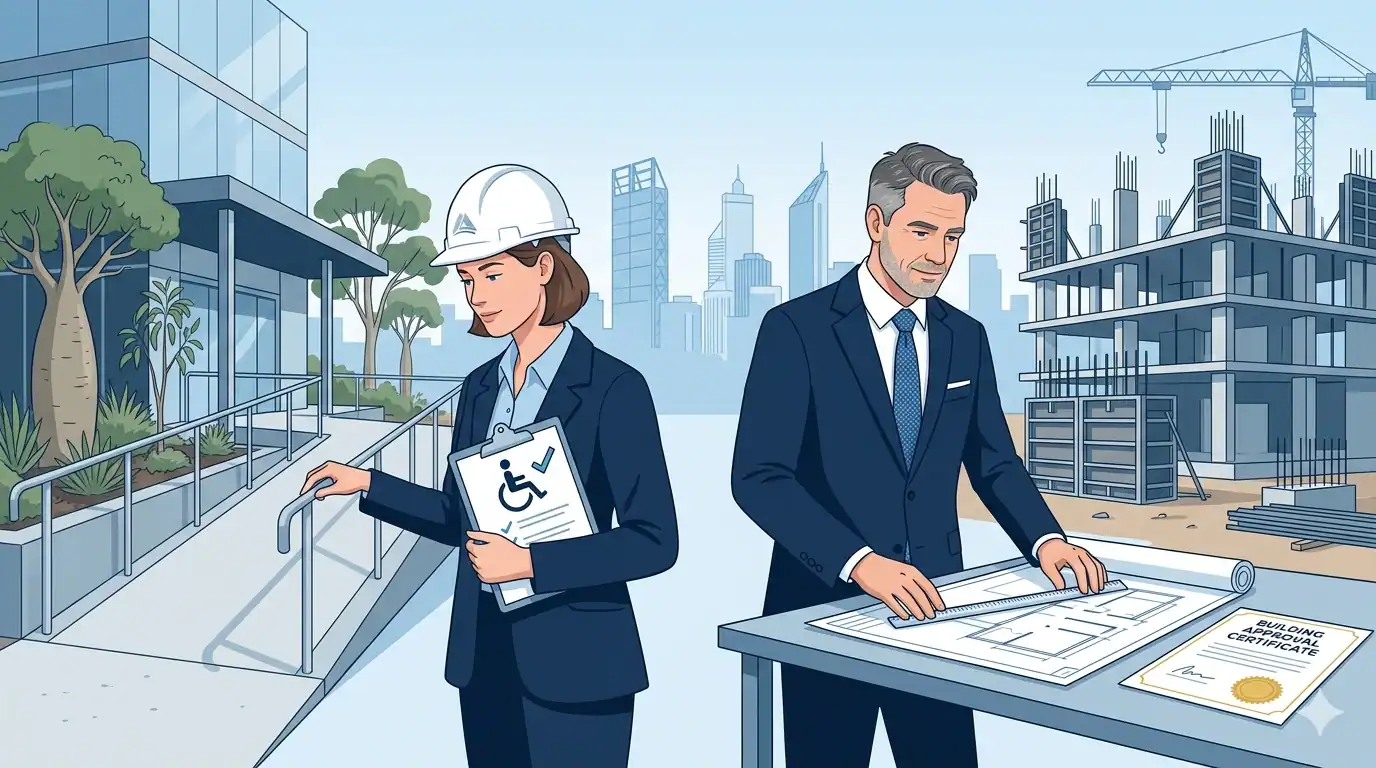
If you’re considering building or renovating in Australia, understanding the roles of the various parties involved can save you time, money and a lot of legal hassle. An access consultant is a specialist who makes sure that buildings comply with disability access and inclusion legislation in Australia, but what’s the difference between an access consultant and a building certifier that Australia relies on for building approvals? This distinction is not only a technical detail – it is a compliance necessity.
Both professionals are important but for very different purposes in building and construction. There is a lot of uncertainty about who to hire and whether to hire both among developers, architects and property owners. This guide helps you to understand the differences, responsibilities and when to use each one.
What Is a Building Certifier in Australia?
An access consultant is a specialist who assesses buildings and spaces to ensure they comply with the Australian accessibility legislation, such as the Disability Discrimination Act 1992 (DDA), the Building Code of Australia (BCA) and the Australian Standards AS 1428 series. They are mainly concerned with inclusive design, ensuring that the built environment is accessible to people with disabilities, mobility impairments and other access requirements to enable them to use it safely and independently.
Access consultants are usually members of the Association of Consultants in Access Australia (ACAA). They have extensive knowledge of path of travel, sanitary facilities, accessible ground surface indicators, luminance contrast, and emergency evacuation planning, among other areas of universal design.
From concept stage, reviewing architectural drawings, to onsite audits during construction, to issuing access reports before final handing over relating to compliance.
What Is a Building Certifier in Australia?
A building certifier Australia professionals use is also known as a building surveyor or private certifier, and is a licensed professional who issues statutory certificates of approval in accordance with state and territory building laws. They are responsible for determining if a proposed or existing building meets the National Construction Code (NCC), local development controls and relevant Australian Standards.
In Australia, a building certifier can provide the following key approvals:
- Construction Certificates (CC)
- Complying Development Certificates (CDC)
- Occupation Certificates (OC)
- Fire Safety Certificates
A building certifier has a legally defined role in relation to the building approval pathway, unlike an access consultant. They are registered under state law (such as the Building Professionals Act 2005 in NSW) and have a statutory responsibility for the certificates they produce.
Over 4.4 million Australians live with a disability, representing approximately 17.8% of the population (ABS, 2022). Accessible building design directly impacts the daily lives of nearly 1 in 5 Australians — making the role of an access consultant more important than ever.
Access Consultant vs Building Certifier Australia: Core Differences
Understanding the distinction helps you build the right team for your project.
| Access Consultant | Building Certifier Australia | |
| Primary Focus | Disability access and inclusive design | Building approvals and code compliance |
| Key Legislation | DDA, AS 1428, Premises Standards | NCC, state building acts |
| Accreditation | ACAA member | State-licensed (e.g., NSW BPB) |
| Deliverable | Access report / audit report | Construction Certificate, OC, CDC |
| Project Stage | Concept to completion | Pre-construction to handover |
| Legal Authority | Advisory and certification support | Statutory certification power |
What are Compliance Building Reports — and Who Makes Them?
Compliance building reports are written reports that verify that a building is compliant with the appropriate legal and regulatory requirements. There are several types of reports, and it’s important to know who is creating each of them.
Access reports and access audit reports are created by an Access consultant. These compliance building reports are used to determine the compliance of a project with the DDA, Disability (Access to Premises – Buildings) Standards 2010 and the AS 1428 series. These are usually a combination of site-specific findings, non-conformance items and recommended remediation strategies. These reports are regularly requested by local councils as part of the Development Application (DA) procedure or by building certifiers for the purposes of issuing a Construction Certificate.
A building certifier prepares statutory compliance building reports, which are associated with the approval process, including inspection reports, compliance certificates and occupation certificates. The following documents provide evidence that the wider construction project complies with NCC and local planning controls.
In many projects there is a need for both types of compliance building report. The access consultant’s report provides information and assistance to the building certifier’s assessment, especially in regard to accessibility provisions in the NCC and Premises Standards.
Is it possible for a Building Certifier to substitute for an Access Consultant?
One of the most frequently asked developer and project management questions.
No — a building certifier is not a substitute for an access consultant. A building certifier in Australia will have a general knowledge of the NCC, but will not necessarily have a broad knowledge of all accessibility legislation. The DDA and Premises Standards are complicated, evolve frequently and are litigated often. An accredited access consultant has specialist training in these areas.
Further, access consultants can also prepare performance solution reports, universal design advice and can undertake on-site accessibility assessments not required by the statutory role of a building certifier. When compliance with the DDA is being challenged or a performance based solution is needed, only a specialist access consultant can produce the technical evidence and documentation.
It is best practice (and often a requirement of the approval process) for any commercial, public or multi-residential development in Australia to involve both professionals.
When is an Access Consultant Required?
Do I need an access consultant for a small renovation or fit-out?
Yes, in many cases. The “affected part” provisions in the Premises Standards and DDA apply when new construction work is being done on an existing building and stipulate that the path of travel to the affected area must also be improved to the current accessibility requirements. An access consultant can provide guidance to you on what is needed, scope the compliance requirements and draft the compliance building reports for your certifier/council.
Is an access consultant required for new residential builds?
New Class 1a homes and Class 2 apartments are now required to comply with minimum accessibility requirements under Livable Housing Design Standards (LHDS) in NCC 2022, which are now mandatory in most states. An access consultant can help you ensure that your design complies with these requirements, and can certify compliance by preparing a formal access report.
What does the process look like when both a building certifier and access consultant are involved?
Generally, the process is as follows:
Concept Stage — The access consultant will review the architectural drawings and provide advice on DDA and AS 1428 compliance.
Access consultant — Work with the access consultant to prepare compliance building reports that accompany the Development Application or Construction Certificate.
Construction Stage — The access consultant reviews the site on a regular basis to ensure that the site is in compliance.
Completion Stage — Occupation Certificate issued by the building certifier, with the access consultant’s sign-off letter stating accessibility compliance has been met.
This holistic solution will help to comply with statutory requirements and accessibility standards without compromising.
Key legislation both professionals work with
Access consultants and building certifiers Australia projects work in parallel regulatory environments. The key instruments include:
Federal Disability Discrimination Act 1992 (DDA) — legislation banning disability discrimination in access and use of buildings.
Disability Standards for Access to Premises – Buildings 2010 — Technical standards that set minimum access requirements for public buildings, under the DDA.
National Construction Code (NCC) / BCA — Contains both performance and prescriptive requirements for all buildings, including Section D and Section F for access and facilities.
AS 1428 Series — Australian Standards for access and mobility, which are referred to in the NCC for technical specifications of ramps, doorways, toilets, signage and more.
Livable Housing Design Standards (NCC 2022 / 2025) — Newer requirements for accessible features for residential buildings at a base level.
Why Getting Both Right Matters
Not hiring the right people at the right time can have significant ramifications. Non-compliant buildings place property owners at risk of DDA complaints, Federal Court proceedings and expensive access features being added after the building is constructed. In addition to legal liability, inaccessible buildings are denying access to a large part of the Australian population to these essential spaces.
The access consultant makes your project accessible for all. Australia developers of the building certifier make sure that your project is legally approved. They offer a full compliance solution, from inclusive design to final certification.
AllCert Group’s team consists of certified access consultants and building certification consultants, who are experienced and work together with you from concept to completion. We draft comprehensive compliance building reports, carry out access audits and offer the guidance required to navigate Australia’s intricate regulatory landscape with confidence.
Final Thoughts
For any development, renovation or fit-out in Australia, you simply cannot afford not to know the difference between an access consultant and a building certifier. Both are different roles, both are required on most medium to large projects and both ultimately achieve the same aim – a building that is safe, compliant and accessible to all Australians.
Need help determining what your project requires? Call AllCert Group today for a consultation regarding access compliance and building certification all over Australia.